.png?width=258&height=54&name=Landice_logo%20(1).png)
The Science Behind Treadmill Running vs. Outdoor Running
February 11, 2026

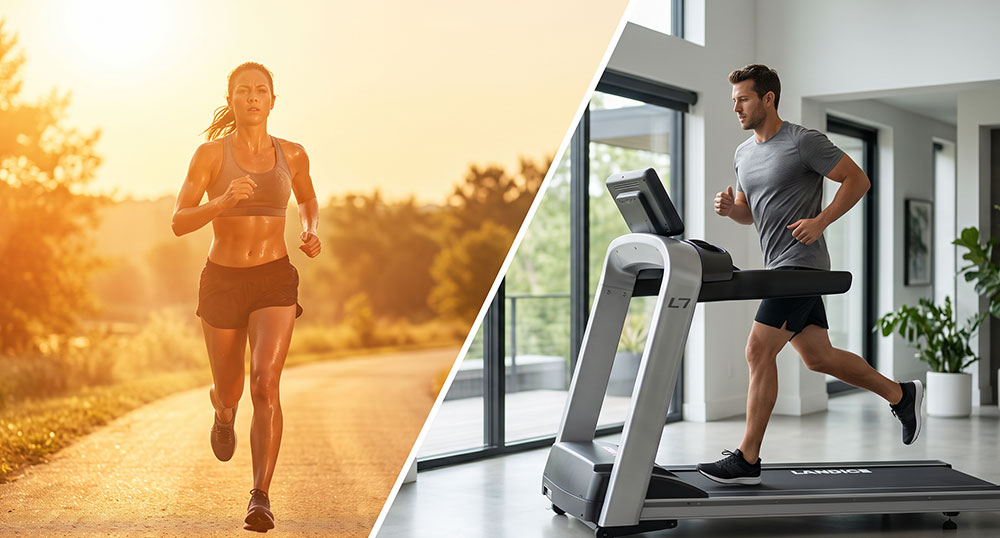
Running is one of the most efficient and studied forms of exercise, but where you run can influence how your body responds. Treadmill running and outdoor running both deliver cardiovascular, metabolic, and musculoskeletal benefits, yet the physiological demands are not identical.
Understanding these differences helps runners train smarter, reduce injury risk, and choose the environment that best supports their goals. Let’s break down the science behind treadmill running versus outdoor running, and why a high-quality treadmill like the ones Landice manufactures can be a powerful training tool.
Cardiovascular Demand and Energy Expenditure
From a cardiovascular standpoint, both treadmill and outdoor running can achieve comparable heart rate and oxygen consumption (VO₂) when speed and effort are matched. However, subtle environmental factors influence how hard the body must work.
Outdoor Running
- Air resistance slightly increases energy cost, especially at faster speeds.
- Variable terrain and wind can raise cardiovascular demand unpredictably.
- Heat, cold, and humidity directly affect heart rate and perceived exertion.
Treadmill Running
- At flat grades, energy cost is marginally lower due to the absence of air resistance.
- Research shows that adding a 1% incline closely mimics the metabolic cost of outdoor running.
- Controlled conditions allow for precise heart rate and intensity targeting.
Science takeaway: When properly programmed, treadmill running can closely replicate outdoor cardiovascular demands while offering superior control over training variables.
Muscle Activation and Biomechanics
Running mechanics are influenced by surface, stride adaptation, and propulsion demands.
Outdoor Running
- Uneven terrain activates stabilizing muscles in the ankles, hips, and core.
- Natural variations in stride length and cadence occur with terrain changes.
- Downhills increase eccentric muscle loading, which can elevate soreness and injury risk.
Treadmill Running
- Belt movement assists leg turnover, slightly altering propulsion mechanics.
- Consistent surface reduces lateral stress and joint variability.
- Modern treadmill decks with shock absorption reduce impact forces compared to pavement.
Science takeaway: Outdoor running enhances neuromuscular variability, while treadmill running offers joint-friendly consistency, which is particularly valuable for high-volume or recovery training.
Impact Forces and Injury Risk
Impact loading is a critical consideration for long-term joint health.
- Concrete and asphalt produce high ground-reaction forces that accumulate over mileage.
- Quality treadmill decks are engineered to absorb shock and reduce peak impact.
- Consistent surfaces lower the risk of acute injuries caused by unexpected terrain changes.
Science takeaway: For runners managing joint stress, prior injuries, or high weekly mileage, treadmill running can significantly reduce cumulative impact without sacrificing training quality.
Environmental and Psychological Factors
Running is not just physical—it’s cognitive and emotional.
Outdoor Running
- Visual stimulation and scenery can reduce perceived effort.
- Weather conditions may enhance mental resilience or limit consistency.
- Seasonal changes often disrupt training schedules.
Treadmill Running
- Climate-controlled environments eliminate heat, cold, wind, and precipitation variables.
- Structured workouts improve focus on pace, heart rate, and form.
- Built-in programming supports interval training, tempo runs, and progressive overload.
Science takeaway: Outdoor running excels at mental stimulation, while treadmill running supports consistency, precision, and adherence, which can be key drivers of long-term fitness.
Precision Training and Performance Gains
From a training science perspective, control equals progress.
Treadmills allow runners to:
- Lock in exact speeds and inclines
- Maintain steady pacing during threshold and tempo runs
- Execute repeatable workouts essential for aerobic development
- Train safely in all seasons without compromising consistency
For competitive runners and fitness-focused athletes alike, this precision enables measurable, repeatable improvement.
Why Treadmill Quality Matters
Not all treadmills deliver the same physiological experience. Inferior machines can introduce belt lag, inconsistent speed, or excessive joint stress.This can alter biomechanics and reduce training effectiveness.
Landice treadmills are engineered for:
- True speed accuracy to ensure metabolic consistency
- Orthopedic shock absorption to protect joints while maintaining a realistic road feel
- Commercial-grade motors and decks that deliver smooth, uninterrupted performance
- Long-term durability that supports years of serious training
The Bottom Line
Both treadmill and outdoor running play important roles in a well-rounded training plan:
- Outdoor running enhances variability, adaptability, and mental engagement.
- Treadmill running delivers precision, safety, and consistency backed by exercise science.
When paired with a high-quality treadmill, runners gain a controlled, repeatable training environment that supports performance, longevity, and year-round progress.
For athletes who care about how their bodies respond and not just how far they run, the science makes one thing clear: where you run matters, and how your treadmill is built matters even more.